

Who Is Setting Your Pace?
Jun 11, 2026
Recently I took part in a webinar with Gianna Driver, Chief People Officer at One Workplace, and Beth White of MeBeBot. We came to talk about a lot of things, but the conversation kept returning to one: the pressure organizations are under right now to adapt and change, and how hard that pressure is landing on the people expected to lead through it.
If you're running a team or a company right now, you already know the feeling. The expectation to move faster, adopt more, and reinvent how you work shows up daily, and it rarely arrives with a map. That pressure has a name. If I had to pick one word for what I'm seeing in organizations right now, it would be anxiety.
Not as a criticism. As a diagnosis. Everywhere I go, whether it's a conference hallway or a leadership offsite, people are carrying the same questions. Am I moving fast enough? Am I doing enough with AI? Is my job safe? Is my company falling behind? Everyone has been navigating this mostly alone, with no shared sense of where the starting line even is. Even those of us deep in this work have days where we walk into a room and suddenly feel like we're not keeping up.
Here's the part we talk about less: organizations have nervous systems too. The same anxiety that lives in individuals is running through companies as systems. Pressure pouring in from the top to do more, faster. People inside unsure how it all fits together, what it means for the work they do today, what it means for where they're headed. When a system is anxious, it behaves the way anxious humans behave. It stops processing and starts reacting.
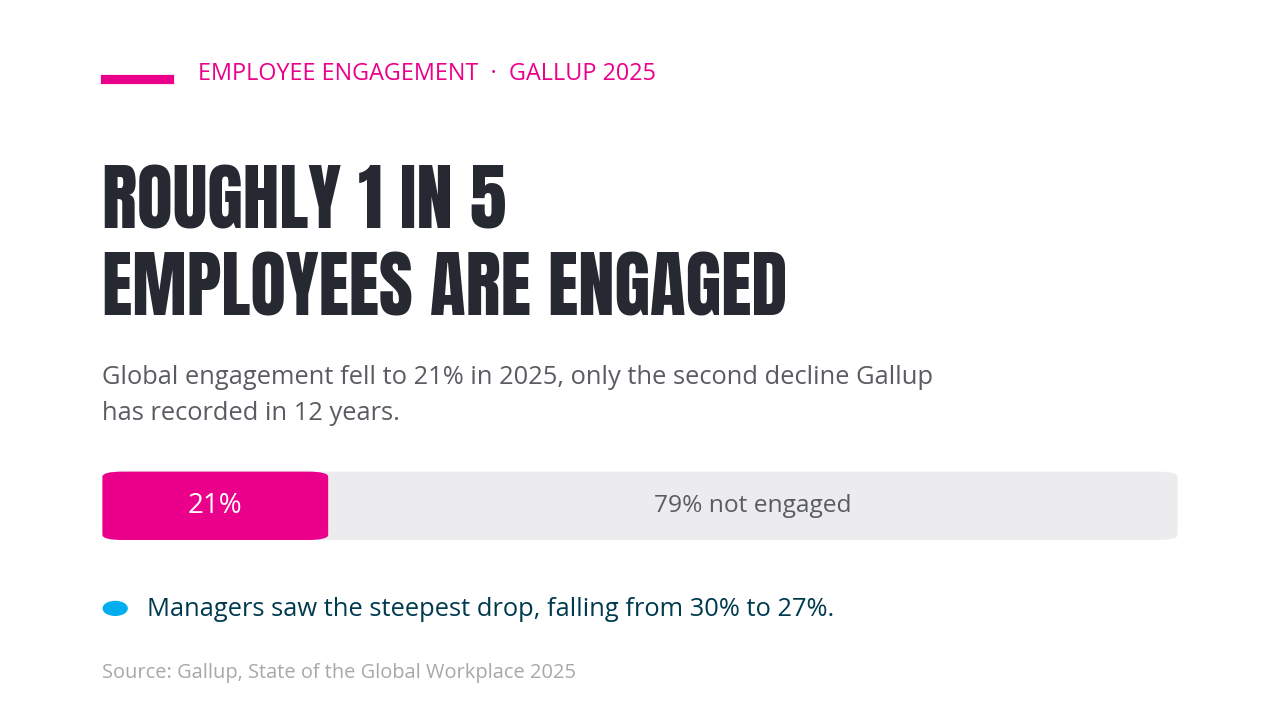
You can see the strain in the numbers. Gallup's 2025 State of the Global Workplace found that just 21 percent of employees worldwide are engaged, only the second decline it has recorded in twelve years. The steepest drop came from managers, the very people we count on to absorb pressure and translate it into something their teams can act on. When the middle of the system is depleted, anxiety doesn't get metabolized. It gets passed along.
The step anxiety deletes
For more than a decade, my work has centered on helping organizations listen to their people. Over those years a simple rhythm emerged: collect, understand, act. Gather good information. Pause to make sense of it. Then decide, deliberately, what to do. And then repeat.
The middle step is the one that matters most, and it's the one anxiety deletes. Humans are collecting information constantly. Under stress, we jump straight from input to action. There's solid behavioral research behind this: the moment between taking in information and acting on it is where judgment lives. React too fast and we're acting on emotion, and emotion alone rarely makes our best decisions for us.
You can hear the difference inside companies. Reactive organizations bounce from data point to decision to new data point to new decision, accumulating mistakes and carrying that debt with their people. Responsive organizations build in the pause. Not a stop. A pause with a purpose: what did we just learn, what do we believe about it, what deserves action.
If this sounds like a luxury, consider who already works this way. The military does. Emergency medicine does. The highest-stress environments we know of long ago learned to build sense-making into their process precisely because the pressure is so high. The rest of us are just now joining them, because the stable world where we didn't need it is gone.
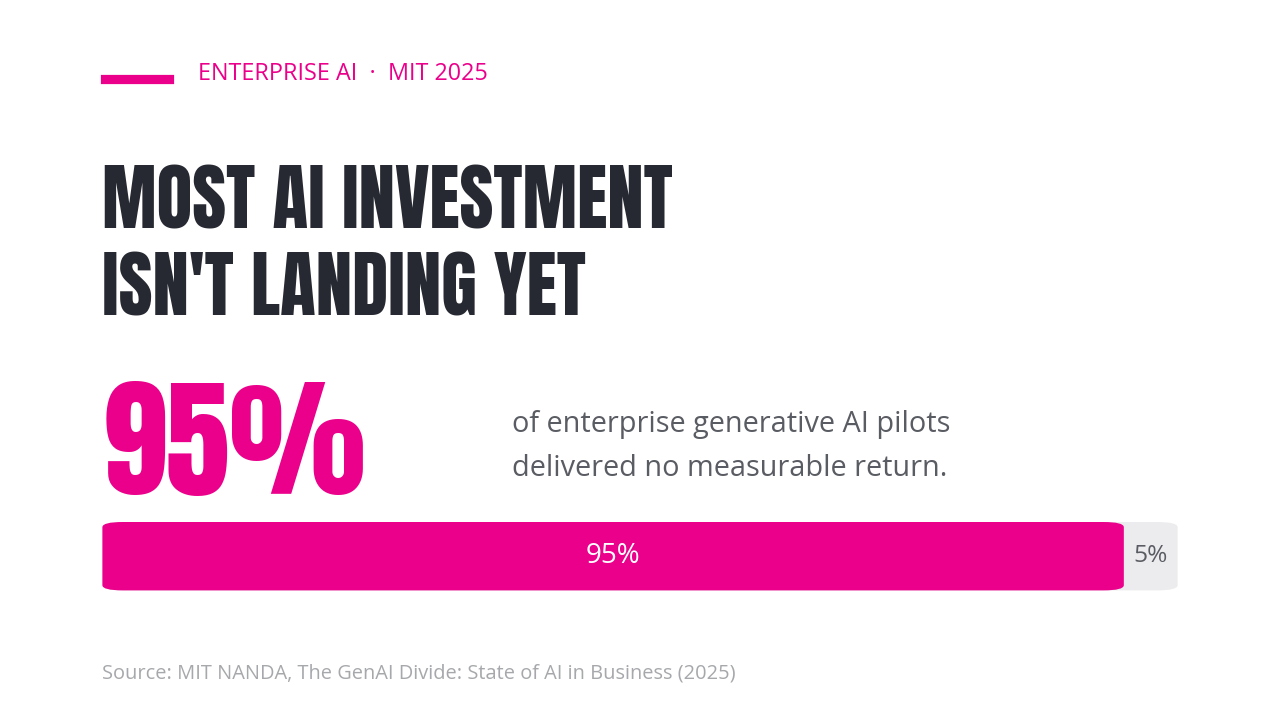
And we're already seeing what happens when that step gets skipped at scale. Enormous sums are being spent on AI right now, and in many organizations the results aren't matching the investment. A 2025 study from MIT looked at enterprise AI and found that 95 percent of generative AI pilots had delivered no measurable return. What's telling is where the researchers placed the blame. Not on the technology, but on what they called a learning gap: the failure to integrate these tools into the actual workflows, structures, and culture of the organization. In other words, the human part. The part that takes a pause to get right.
What slowing down actually looks like
In our conversation, Gianna told a story I keep thinking about. Her team needed to revamp sales commission plans on a tight timeline. The instinct was ship it now, fix it later. But the feedback coming back was clear: the very plan meant to motivate people was creating friction, because change was happening to them, not with them. So leadership did something that takes real nerve. They acknowledged it directly, extended the existing plans to buy time, and ran roundtables to bring the sales team into the design. The plan that eventually shipped was better, and more importantly, people were behind it.
I shared a parallel story from my own client work. A growing construction company, new to employee listening, ran a small pilot and immediately learned that people wanted more feedback on their performance. Leadership wanted to launch a performance program right away. My advice was to hold off until the full listening program finished, then announce the same initiative as a response to what employees had said. Same decision. Completely different reception. One version feels like another thing being done to people. The other says: we heard you, and here's what we're doing about it.
That's the quiet truth underneath all of this. Whatever the tool, whatever the strategy, people want to feel seen and heard. The more people feel they came to a decision themselves, the more durable the change. That's not soft. It's how motivation works, and there's decades of research behind it. Buy-in isn't a nice-to-have on the critical path of transformation. It is the critical path.
No rush, no pause
Years ago, during a hard transition of my own, Diana Chapman of the Conscious Leadership Group gave me four words that have stayed with me since: no rush, no pause.
Keep moving. Don't sprint blindly, and don't freeze. It's the posture I'd offer any leader right now, because anxiety pushes us toward both extremes at once: frantic motion or paralyzed waiting.
And there's a sports analogy that landed hard when I moderated a panel at Human Tech Week in San Francisco recently. In basketball, great teams don't just play the game, they control its tempo. A weaker team can drag you into their pace, and suddenly you're burning energy on their terms, making rushed decisions, wearing yourself down. The art, especially on offense, is holding your own tempo regardless of the chaos around you.
Right now the outside world is playing very fast, and it wants your organization to match it. Vendors, headlines, competitors, boards. All of it is pace-setting pressure. But you are not a victim of the game around you. The question worth bringing to your next leadership conversation is simple: are we setting our pace, or is it being set for us?
The organizations that come through this transformation strongest won't be the ones that moved fastest. They'll be the ones that kept moving, kept listening, kept making sense of what they learned, and brought their people with them. Collect, understand, act. Repeat.
No rush. No pause.
Want to know where your listening program actually stands?
Craig Forman is the founder of CultureC, where he helps organizations connect employee listening to leadership decisions. The free Culture Assessment helps you see exactly where your organization is in the collect, understand, act cycle and which step is most at risk of getting skipped under pressure.